
The exhibition Mexico at Midnight: Film Noir from Mexican Cinema’s Golden Age (running July 23-29) celebrates the brilliance of Mexican cinema’s época de oro — a time during the mid-1930s to the early 1960s when Mexican films dominated Latin America and made significant inroads into Spanish-speaking communities in the U.S.
At its height, Mexican popular filmmaking achieved a level of quality fully comparable to Hollywood, with a robust star system (with such magnetic performers as Dolores de Rio, Pedro Armendáriz, Maria Felix, and Arturo de Cordova), world-class directors like Roberto Gavaldón, Julio Bracho, and Emilio Fernandez, cinematographers such as Gabriel Figueroa and Alex Phillips, and the superb technical facilities of the Churubusco Studios.
This exhibition features seven films from the Golden Age of Mexican filmmaking which bring the lesser-known Mexican production of film noir into the spotlight. Additionally, the two films screening on July 23 will be introduced by Daniela Michel, Founding Director of Festival Internacional de Cine de Morelia, and José Manuel García of Filmoteca UNAM.
Mexican Noir
Screening Schedule
July 23, 2015–July 29, 2015
Thursday, July 23, 2015
4:00 En La Palma de tu mano (In the Palm of Your Hand). 1951. Directed by Roberto Gavaldón. With Arturo de Córdova, Leticia Palma, Ramón Gay. With the slightly frayed good looks of an aging matinee idol, Arturo de Córdova became Mexcan noir’s perfect patsy, helplessly in thrall to his erotic obsessions. The title of Robert Gavaldón’s film cuts two ways: As the fraudulent fortune teller Professor Karin, Córdova uses the secrets of his female clientele to blackmail them, while at
the same time he is a pawn in the higher game being played by a treacherous widow (Leticia Palma). 113 min. Theater 3, mezzanine, Education and Research Building. Introduced by Daniela Michel and José Manuel García.
7:00 La Otra (The Other One). 1946. Directed by Roberto Gavaldón. With Dolores del Rio, Agustín Irusta, Víctor Junco. Gavaldón collaborated with his favorite screenwriter, José Revueltas, to create this distinctly Mexican variant on the time – honored Evil Twin plot: this time, it’s the great Dolores del Rio, returning to Mexico from her Hollywood period, who plays the central dual role, as a meek, bespectacled manicurist and her mercenary, man-eating sister. But in this case, envy proves to be a greater sin than avarice. 98 min. Theater 3, mezzanine, Education and Research Building. Introduced by Daniela Michel and José Manuel García.
Friday, July 24, 2015
4:00 La Noche avanza (Night Falls). 1952. Directed by Roberto Gavaldón. With Pedro Armendáriz, Anita Blanch, Rebeca Iturbide. This Gavaldón classic suggests that what the boxing world is to the American film noir, the high-speed game of pelota (jai alai to American tourists) is to its Mexican cousin. Pedro Armendáriz, Mexico’s great romantic lead, plays against type as an arrogant pelotari who seduces and discards women at will, until he becomes the target of a cunning revenge plot. He meets his fate in a final image that is as quintessentially noir as it is inconceivable in an American film. 85 min. Theater 2, T2
7:00 La Diosa arrodillada (The Kneeling Goddess). 1947. Directed by Roberto Gavaldón. With María Félix, Arturo de Córdova, Rosario Granados. The amazing María Félix—imagine the love child of Rita Hayworth and Ava Gardner—is the artist model who leads the ever-hapless Arturo de Córdova away from the arms of his innocent, blue-eyed wife and down, down, down into the ecstatic depths of degradation—which include a stop at a memorably seedy Panamanian nightclub. 107 min. Theater 2, T2
Saturday, July 25, 2015
4:30 Crepusculo (Twilight). 1945. Directed by Julio Bracho. With Arturo de Córdova,
Gloria Marín, Julio Villarreal. Julio Bracho’s geometric mise en scène pinpoints surgeon Arturo de Córdova as a victim of fate before we even glimpse his face in this very stylish drama, which was Mexico’s entry at the 1947 Venice Film Festival. One glimpse of the woman he loved (Gloria Marin) but who abandoned him is enough to propel the good doctor into a voluptuous surrender to “the twilight that lies between day and night, beauty and crime.” 108 min. Theater 2, T2
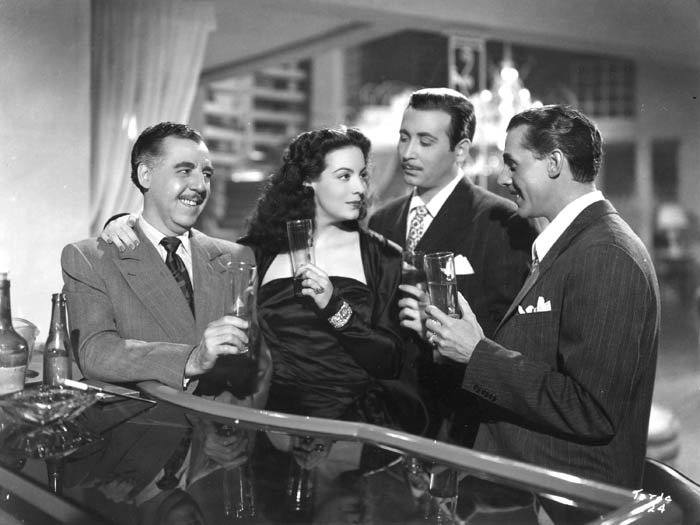
Que Dios Me Perdone (May God Forgive Me). 1948. Mexico. Directed by Tito Davison. Courtesy Filmoteca UNAM
7:30 En La Palma de tu mano (In the Palm of Your Hand). 1951. Directed by Roberto Gavaldón. With Arturo de Córdova, Leticia Palma, Ramón Gay. With the slightly frayed good looks of an aging matinee idol, Arturo de Córdova became Mexcan noir’s perfect patsy, helplessly in thrall to his erotic obsessions. The title of Robert Gavaldón’s film cuts two ways: As the fraudulent fortune teller Professor Karin, Córdova uses the secrets of his female clientele to blackmail them, while at
the same time he is a pawn in the higher game being played by a treacherous widow
(Leticia Palma). 113 min. Theater 2, T2
Sunday, July 26, 2015
2:00 La Otra (The Other One). 1946. Directed by Roberto Gavaldón. With Dolores del Rio, Agustín Irusta, Víctor Junco. Gavaldón collaborated with his favorite screenwriter, José Revueltas, to create this distinctly Mexican variant on the time – honored Evil Twin plot: this time, it’s the great Dolores del Rio, returning to Mexico from her Hollywood period, who plays the central dual role, as a meek, bespectacled manicurist and her mercenary, man-eating sister. But in this case, envy proves to be a greater sin than avarice. 98 min. Theater 2, T2
5:00 La Noche avanza (Night Falls). 1952. Directed by Roberto Gavaldón. With Pedro Armendáriz, Anita Blanch, Rebeca Iturbide. This Gavaldón classic suggests that what the boxing world is to the American film noir, the high-speed game of pelota (jai alai to American tourists) is to its Mexican cousin. Pedro Armendáriz, Mexico’s great romantic lead, plays against type as an arrogant pelotari who seduces and discards women at will, until he becomes the target of a cunning revenge plot. He meets his fate in a final image that is as quintessentially noir as it is inconceivable in an American film. 85 min. Theater 2, T2
Monday, July 27, 2015
4:00 La Diosa arrodillada (The Kneeling Goddess). 1947. Directed by Roberto Gavaldón. With María Félix, Arturo de Córdova, Rosario Granados. The amazing María Félix—imagine the love child of Rita Hayworth and Ava Gardner—is the artist model who leads the ever-hapless Arturo de Córdova away from the arms of his innocent, blue-eyed wife and down, down, down into the ecstatic depths of degradation—which include a stop at a memorably seedy Panamanian nightclub. 107 min. Theater 2, T2
7:00 Que Dios me perdone (May God Forgive Me). 1948. Directed by Tito Davison.
With María Félix, Fernando Soler, Julián Soler. María Félix stars as a dark lady with a dark past who appears in neon-lit, spy-infested Mexico City at the height of World War II; betrayal and death are not far behind. The film’s most memorable sequence is a languid double murder, accompanied by Félix’s performance of a swooning love song. Directed by Tito Davison (The Big Cube) from a story by the poet Xavier
Villaurrutia. 91 min. Theater 2, T2
Tuesday, July 28, 2015
4:00 Distinto amanecer (Another Dawn). 1943. Directed by Julio Bracho. With Andrea Palma, Pedro Armendáriz, Alberto Galán. Mexico at midnight as photographed by the legendary Gabriel Figueroa. Julieta (Andrea Palmer), the disaffected wife of a failed civil servant, is thrilled to re-encounter Octavio (Pedro Armendáriz), a former lover who is now a union activist on the run from a corrupt politician. Hoping to help him, she descends into the Mexican underworld, where she finds a purpose —and a thrill— missing from her married life. Bracho’s direction approaches the precision of Fritz Lang, while Figueroa proves himself a master of both nocturnal interiors and sun –
baked landscapes. 106 min. Theater 2, T2
7:00 Crepusculo (Twilight). 1945. Directed by Julio Bracho. With Arturo de Córdova, Gloria Marín, Julio Villarreal. Julio Bracho’s geometric mise en scène pinpoints surgeon Arturo de Córdova as a victim of fate before we even glimpse his face in this very stylish drama, which was Mexico’s entry at the 1947 Venice Film Festival. One glimpse of the woman he loved (Gloria Marin) but who abandoned him is enough to propel the good doctor into a voluptuous surrender to “the twilight that lies between day and night, beauty and crime.” 108 min. Theater 2, T2
Wednesday, July 29, 2015
4:00 Que Dios me perdone (May God Forgive Me). 1948. Directed by Tito Davison.
With María Félix, Fernando Soler, Julián Soler. María Félix stars as a dark lady with a dark past who appears in neon-lit, spy-infested Mexico City at the height of World War II; betrayal and death are not far behind. The film’s most memorable sequence is a languid double murder, accompanied by Félix’s performance of a swooning love song. Directed by Tito Davison (The Big Cube) from a story by the poet Xavier Villaurrutia. 91 min. Theater 1
7:00 Distinto amanecer (Another Dawn). 1943. Directed by Julio Bracho. With Andrea Palma, Pedro Armendáriz, Alberto Galán. Mexico at midnight as photographed by the legendary Gabriel Figueroa. Julieta (Andrea Palmer), the disaffected wife of a failed civil servant, is thrilled to re-encounter Octavio (Pedro Armendáriz), a former lover who is now a union activist on the run from a corrupt politician. Hoping to help him, she descends into the Mexican underworld, where she finds a purpose —and a thrill— missing from her married life. Bracho’s direction approaches the precision of Fritz Lang, while Figueroa proves himself a master of both nocturnal interiors and sun- baked landscapes. 106 min. Theater 2, T2

