

La agrupación Ayazamana interpretando bailes de la tradición Inca. Fotos Javier Castaño
El Festival por el derecho al voto de los residentes en las elecciones locales se tomó la calle 78 de Jackson Heights, Queens. “Nuestro movimiento sigue creciendo”, dijo David Andersson, del Partido Humanista y líder de esta lucha en la ciudad de Nueva York. El desfile de artistas atrajo a decenas de personas que disfrutaron del clima, la música y la información.
Se presentaron grupos como EartheDriver y Kofre, que no sólo interpretaron lo mejor de repertorio de música rock, soul y hip-hop, sino que se expresaron a favor de este movimiento. La lírica de Kofre se refiere a la explotación de los inmigrantes y a la necesidad de organizar un frente común por la libertad de expresión y los derechos humanos. “Tenemos que conquistar el derecho al voto en esta ciudad de inmigrantes”, dijo Jeremiah Hosea de EarthDriver.
La organización Poetas en Nueva York envió a varios de sus miembros, quienes leyeron textos de amor, guerra, inmigrantes y lucha por la paz. “Estamos cansados de la explotación a los inmigrantes en esta ciudad en donde no hay espacios para el amor y la convivencia”, dijo el poeta Nicolás Linares.
El guitarrista argentino Victorio Menghi subió a la tarima al igual que Yinka Olewole, artista acústico de Nigeria. También estuvo la agrupación Bright de música reggae de Ghana.
La mayoría de los aplausos fueron para la agrupación de danzas ecuatorianas Ayazamana, quienes bailaron con trajes típicos los ritmos ancestrales del Imperio Inca.
Este festival es hasta ahora el más progresista y multiétnico que se haya realizado en Queens a favor de los inmigrantes. “El objetivo de este movimiento por el derecho al voto de los residentes es importante y ha demostrado su conexión con la comunidad”, dijo el profesor y autor Ron Hayduk.
Para má información sobre el derecho al voto de los inmigrantes, visite este link: ivotenyc.org
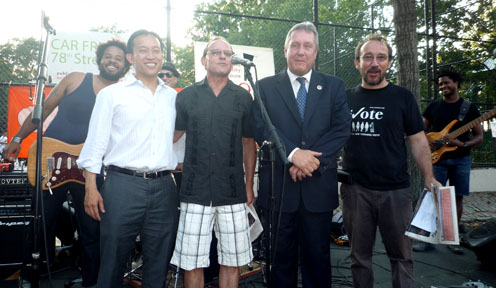
Desde la izquierda, David Chiu, presidente de la Juta de Supervisores de San Francisco y candidato a la alcaldía de esa ciudad del oeste. profesor Ron Hayduk, concejal Daniel Dromm y David Andersson.
La concejal Julissa Ferreras estuvo al comienzo del festival y habló a favor del derecho al voto de los residentes locales. “Esta es una ciudad de inmigrantes y el derecho al voto fortalece nuestra democracia”, dijo Ferreras.
El concejal Daniel Dromm también habló a favor de este movimiento y dijo que sólo faltan 4 concejales para que firmen el apoyo de este movimiento y así presentarlo a votación en el Concejo de la ciudad de Nueva York.
Durante este Festival, varias organizaciones comunitarias distribuyeron información sobre sus programas, como Queens Community House, Voces Latinas, DRUM, Humanist Party, NYC Participation Project, Jackson Heights Green Alliance, Chhaya CDC y New Immigrant Community Empowerment (NICE).
Los organizadores también imprimieron un periódico que distribuyeron durante el Festival y en la fiesta de clausura en el bar y restaurante Novo de la 37 avenida y la calle 79 de Jackson Heights.
El siguiente artículo es del profesor Arturo Sánchez, Ph.D y presidente del Comité Nuevos Inmigrantes de la Junta Comunal 3 del condado de Queens. Se refiere a la importancia social del derecho al voto de los inmigrantes.
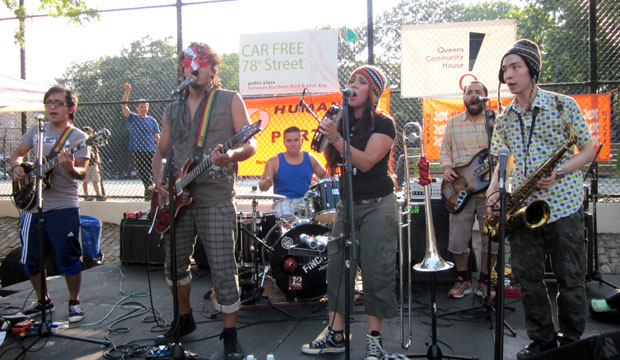
La agrupación Kofre con su lírica pro inmigrante atrajo la atención del público.
MUNICIPAL VOTING RIGHTS
By Arturo Ignacio Sanchez published July 19, 2011
From 1776 through 1926, forty states and federal territories in the United States granted non-citizen residents the right to vote in local, state, and federal elections. Contrary to conventional wisdom, immigrant voting rights have long been a central component in the U.S. political landscape. In this regard, the U.S. Constitution does not establish an obligatory connection between citizenship and voting rights. Moreover, the Supreme Court has upheld voting by non-citizens.
New York City – as an iconic city of immigrants – illustrates the value added benefits associated with re instituting immigrant voting rights. Implementing immigrant voting rights would socialize our newest New Yorkers in the civic and political obligations of U.S. citizenship while maximizing voter involvement and government accountability. When one considers that the average wait-time for obtaining U.S. citizenship has increased from 8 to 10 years, non-citizenship voting is an important element in increasing immigrant incorporation, strengthening our fragile democracy, and cultivating the social capital and accompanying neighborhood stability generated by residential engagement in civic and community affairs.
At present, more than 1 million adult immigrant New York City residents are denied the opportunity to vote in local elections. This inequitable scenario is compounded by the crucial contributions that immigrants make to the local and regional economy. In New York State, immigrants generate $229 billion in economic output which accounts for 22.4% of the state’s gross domestic product. In addition, documented immigrants pay $18.2 billion in taxes which represents 15.5% of the state’s income tax receipts. This is a socially unjust and untenable situation.
According to the latest U.S. Census, 36% of the city’s population is foreign-born, with over one-quarter having arrived in the year 2000 or later. Although the Census 2010 – according to Mayor Bloomberg – dramatically undercounted the recent growth in immigrants and their off-spring, they nonetheless play a crucial role in the allocation of scarce federal resources because funding is calculated on the basis of population. Yet, non-citizen residents are denied the opportunity to participate in the political decisions that structure their life chances as New Yorkers.
In addressing this undemocratic process, the chairperson of the NYC Council’s Committee on Immigration – Councilperson Daniel Dromm (CD 25) – is leading the political movement to amend the New York City Charter by championing Int. No. 410. This legislation would authorize non-citizen residents to vote in municipal elections. Presently the bill has 21 co-sponsors – five short of the 26 need for approval by the City Council. As things stand, Councilperson Dromm feels that “We have a good shot in passing the bill. America was founded on ‘no taxation without representation.’ So to argue against the bill is un-American.” Is New York’s political class up to the task of revitalizing our local democratic system? If not now, when?
Arturo Ignacio Sanchez, Ph.D. is an urban planner and chairperson of the “Newest New Yorkers/Immigration Committee,” Community Board 3, Queens.

