
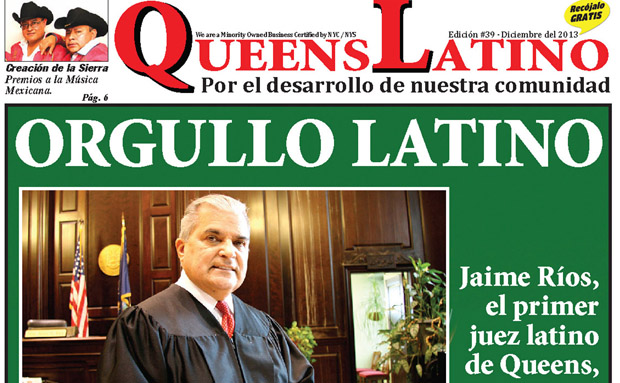
Portada de la edición de diciembre del 2013 de QueensLatino. Foto del Juez Jaime Ríos en la Corte Suprema de Queens por Javier Castaño
El abogado de origen puertorriqueño Jaime Ríos fue el primer juez latino elegido en Queens a las cortes de vivienda, civil, de apelaciones y suprema. Abrió las puertas para que otros jueces latinos fueran elegidos en este condado. QueensLatino fue la publicación oficial de la fiesta de despedida del juez Ríos, organizada por la jueza Carmen Velásquez. Acudieron más de 200 personas entre jueces de Queens y Brooklyn, amigos y familiares de este juez que deja un legado de dedicación y justicia. Carlos Vélez, nuestro columnista, fue de los que impulsó el nombre de Ríos para que fuera elegido en 1993 a la Corte Civil.
A continuación publicamos un texto en inglés sobre el ascenso del Juez Jaimé Ríos, quien vivirá desde este mes entre el estado de Florida y la isla de Puerto Rico.
Adiós Judge Jaime Ríos
After more than three decades as a public servant, New York State Supreme Court Justice Jaime A. Rios is hanging up his proverbial black robe and moving to sunnier and warmer quarters.
Justice Rios is saying adios to the very serious and staid quarters at the Jamaica, Queens, courthouse where he has heard thousands of cases for more than a decade and a half, and saying hello to the white sands of Florida and Puerto Rico.
His Honor’s long and distinguished public service career dates back to the late 70s when he accepted a position as Assistant District Attorney in Brooklyn. In 1980, he was named special counsel to the Police Commissioner and in 1982, Rios was promoted to Deputy Commissioner for trials, one of the most sensitive and important jobs in City government.
Besides law, Justice Rios’ passion has always been education. Born in the South Bronx, he is a graduate of James Monroe High School and has an undergraduate degree in Education from City College and a Master’s, also in education, from New York University.
In 1977, he earned his Juris Doctor degree from Fordham University. With that degree in hand, Rios was on his way to becoming a positive role model for countless Latinos in New York City.
A tireless advocate for education as the only and best way to get ahead in life, Rios has been part of the education system in New York, all of his adult life, from being a teacher for the New York City Board of Education in the early 70’s to being an adjunct professor at the Fordham Law School, where he still teaches.
Rios ascension to the state Supreme Court in 1994, was a tough road. It all started in 1988 when he ran for Civil Court. The local Democratic Party refused to endorse him. He was told “it wasn’t the time for Hispanics”.
The lack of County support didn’t discouraged Rios, but made him even more determined to run, and plan B was put into motion. He ran on the Liberal Party ticket and lost, but garnered almost 15,000 votes ; an impressive show. Not too bad for a young, unknown and inexperienced campaigner.
He tried again in 1989, with similar results, but this time he received more than 17,000 votes. An even better show only a year later, if you consider the limited resources of the Liberal Party and that Rios was Latino.
Those loses were his gains, and after two failed campaigns, politicians began to take notice of this young, bright and strong-minded Latino judge.
They saw how determined and persistent he was. Rios continued to campaign and get his name known. He made a point of participating in Latino community events, whenever it was possible. He courted the press, hosted a Sunday morning Spanish language radio show, published articles on legal topics, both in Spanish and English and became involved in local community affairs.

Un grupo de jueces latinos integrado por Víctor Marrero, Carol Robles Román, Jaime Ríos (parado en la mitad), Rolando Acosta, Carmen B. Cipatick, Judith Kaye y Sonia Sotomayor (sentada al centro) y quien se convirtió en jueza de la Corte Suprera de los Estados Unidos.
All this work finally paid off and in November 1993, when he was elected to the Civil Court of New York City. This time he was the Democratic Party’s candidate. It was a sweet triumph made even sweeter by the fact that Judge Rios had become the first Latino in Queens ever elected to a public office in a disputed county-wide election. He made history. His momentous achievement opened the proverbial political doors and gave other Latinos the incentive they needed to seek public office in New York City. Thanks to Judge Rios’ historic victory that fateful November in 1993, Latinos everywhere in the city were on the way to becoming an electoral group that those in power could not ignore any longer. The following year he was elected to the State Supreme Court. In that election year, he got more votes in Queens than the two major party candidates for governor.
In 2001, Justice Rios was designated an Associate Justice of the Appellate Term for the 2nd and 11th judicial districts of the New York State Supreme Court, one of the highest judicial posts in the state.
Now in the zenith of his career, Justice Rios is seen by countless young Latinos as a role model and as such, his Honor has some words of advice for them: “One, register to vote and exercise it. Don’t ignore this privilege that countless people around the world would like to have.
“Second, get an education; without it, you are lost. And third, don’t give up your ambitions.” Justice Rios, certainly practiced what he has preached all these years and it shows. He worked his way all the way to the top court in Queens County by following his own advice
Now as he begins to close another of the many chapters in his life, he is ready to embark onto the next.
But first, a long vacation through Latin America is just what the jurors’ found him guilty of needing and the judge sentenced him and his accomplice Kathleen to do. There will be no appeals.
Upon my return, “I plan to start working on a text book on law and after that, a novel based on my experiences as a judge and lawyer,” said Rios, few days before his departure from the Court becomes a reality.

En Ricardo’s by the Bridge, en Astoria, Queens, la jueza Carmen Velásquez comparte con el juez Jaime Rios, copa en mano, al lado del pintor Abraham Ushima, quien hizo un cuadro con el rostro del juez que se jubiló. Foto Javier Castaño
Education and law have been the pillars of Rios’ professional life and in both he has excelled beyond what many people thought back in 1977, a young Latino lawyer fresh out of law school could.
When asked what aspect of his judicial office was most difficult, he responded: “how to convince our citizens of the importance of jury service. It is very frustrating to see the lack of interest of the public to serve as jurors. Jury service is very important to our democracy,” said Rios with a bit of exasperation in his voice.
But, his exasperation ebbs as his thoughts turn to the moment –only couple of weeks away- when his Honor and bride Kathleen will be serving their sentences traveling in Latin America and enjoying the sunny beaches of the Atlantic and the Pacific Oceans. Bon Voyage Justice Rios, you earned it the hard way!
Por Carlos Vélez
Veljia47@yahoo.com


La fiesta de retiro de el Juez Jaime Ríos de la Corte Suprema de el Estado de Nueva York fue un total éxito. Mas de 200 personas fueron a la fiesta, incluyendo 52 Juezes de otros condados y differences cortes. Lo felicito y le agradezco por su labor. Suerte amigo.
Juez Carmen Velásquez
Corte Civil, Condado de Queens, NY
Siempre es noble el reconocer los triunfos, los logros y las enseñanzas que nos dejan los que se van. El Honorable Jaime Rios no se va solo, se retira y siempre estara entre nosotros dandonos lo que el mas tiene, sus conocimientos experiencia y sabiduria Feliz de compartir ESTA FIESTA QUE A PROPOSITO ESTUvO A LA ALTURA DE LA OCASION, DIOS LE BENDIGA